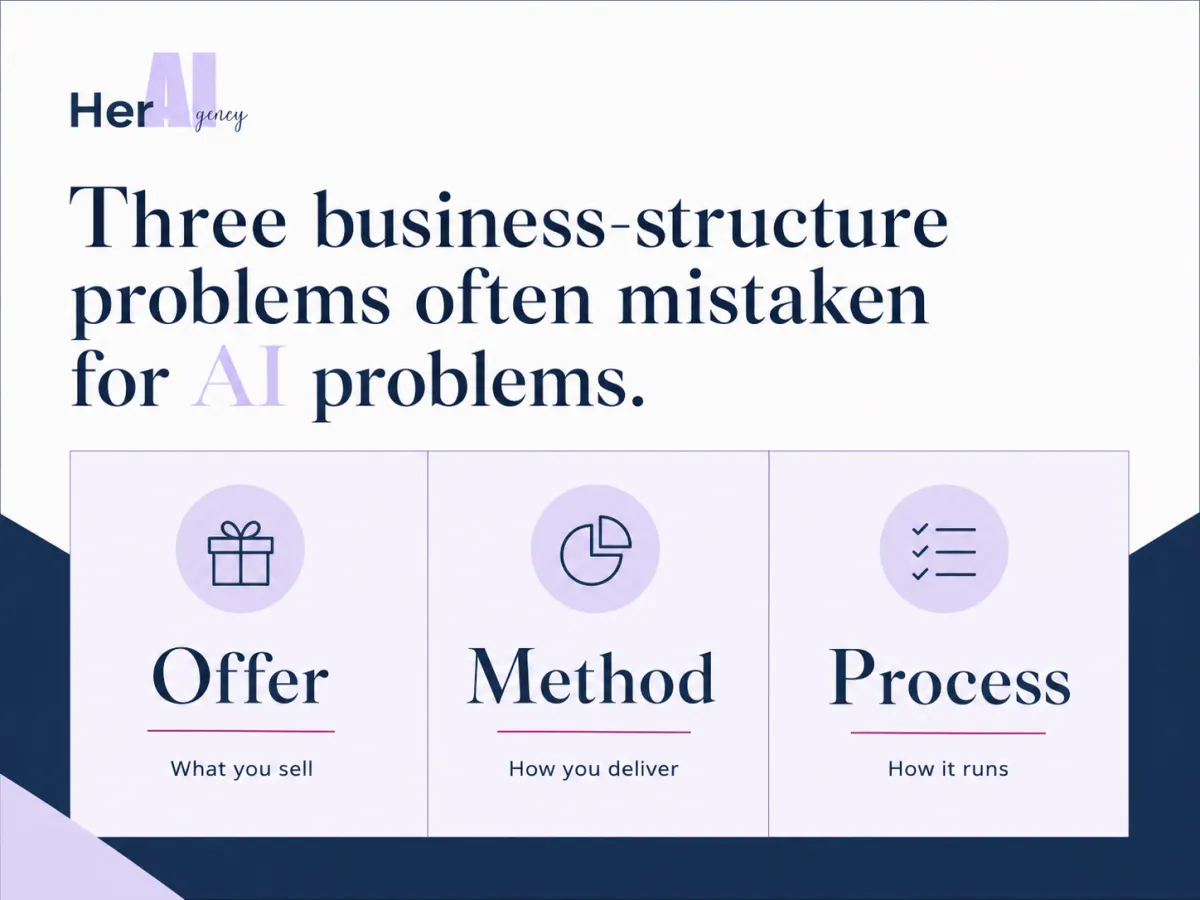
Three Problems Founders Call AI Problems That Are Actually Business-Structure Problems
When AI output misses the mark, the tool gets blamed first.
The founder tries a different model, buys another template, rewrites the prompt, or adds a new automation.
Sometimes the tool is the wrong fit.
Often, the tool is exposing a problem that already existed.
AI makes unclear offers harder to ignore. It reveals how much of the methodology lives only in the founder’s head. It shows where the process depends on memory, judgment, or ownership that no one has documented.
Those are not software problems.
They are business-structure problems.
Here are three of the most common.
Problem 1: The offer is not clear enough
What the founder calls the AI problem
“The AI does not understand what I sell.”
“The copy sounds vague.”
“It keeps describing my work like generic coaching or consulting.”
“The tool combines services that should stay separate.”
What may actually be happening
The offer is clear in conversation, but not clear in the business documentation.
The founder knows what the offer is because she built it. She understands the history, the edge cases, the buyer, and the difference between this service and the one next to it.
The tool sees a short description, a sales page, and a few scattered notes.
If those sources use different language, the tool has no reliable way to know which version is current.
If the offer is defined mainly by deliverables, the tool may miss the real problem it solves.
If the offer tries to serve several audiences at once, the output becomes broad.
If two services overlap, AI may blend them into one.
What to document
For each offer, write down:
Who it is for
The situation that makes someone ready
The exact problem it solves
What the buyer receives
How the work is delivered
What the offer does not include
Which offer comes before or after it
When another service is the better fit
The approved public description
The claims that require proof
Then compare that definition with the website, proposals, profile, CRM, and AI knowledge base.
If the descriptions do not match, the AI tool is not the only source of confusion.
Diagnostic question
Could a contractor, employee, and AI tool explain the offer in the same way without the founder correcting them?
If not, the offer needs a shared definition.
Problem 2: The methodology is still undocumented
What the founder calls the AI problem
“The content does not sound like an expert wrote it.”
“It gives obvious advice.”
“It misses the nuance.”
“It cannot explain what makes my approach different.”
What may actually be happening
The expertise is real, but the method is implicit.
Experienced founders make decisions quickly because they have seen the pattern before.
They know which question changes the diagnosis. They know when a client is asking for the wrong solution. They
know which step cannot be skipped. They know what to notice before they recommend a tool.
Much of that knowledge feels obvious to the founder because it has become instinct.
It is not obvious to anyone else.
When the method is missing, AI can describe the category, but it cannot reproduce the founder’s reasoning.
That is why the output often sounds polished but shallow.
What to document
Start with one recurring client problem.
Write down:
What you look at first
Which questions you ask
How you identify the real problem
Which options you consider
Which conditions change the recommendation
Which mistakes you see repeatedly
What you do in what order
What the client needs to understand before moving forward
Where human judgment matters
What a strong result looks like
Do not worry about naming the framework first.
Document the thinking before you package it.
Diagnostic question
Can the business explain not only what you do, but how you decide what to do?
If the answer is no, AI is working without the reasoning that makes the expertise valuable.
Problem 3: The process or ownership is inconsistent
What the founder calls the AI problem
“The automation is not working.”
“The follow-up feels disjointed.”
“The tool keeps sending the wrong thing.”
“AI is creating more cleanup.”
What may actually be happening
The process was never clear before it was automated.
Automation does not decide what the business should do. It follows the rules it has been given.
If the intake questions are weak, the workflow routes weak information.
If no one owns the next step, the system creates activity without accountability.
If there are several exceptions and no decision rules, the workflow breaks in the edge cases.
If the founder changes the process verbally but no one updates the system, the automation keeps following the old version.
If the team does not know what requires human review, AI can move too far or not far enough.
What to document
Map the process from the moment someone takes action.
For each step, record:
What triggers the step
What information is required
Who owns it
What decision is made
Which rule controls the next path
What the client receives
What happens if information is missing
What needs human review
How completion is recorded
What happens next
This is not busywork.
It is the operating logic the tool needs.
Diagnostic question
If the founder were unavailable for one week, would the team and the system know what happens next?
If not, the business still depends on memory.
AI exposes the weakest phase
These three problems often appear together.
An unclear offer creates weak content and weak qualification.
An undocumented method creates generic explanations and inconsistent delivery.
An inconsistent process creates missed follow-up, poor routing, and manual cleanup.
HerAIgency organizes these needs into three phases:
Align: Clarify the brand, offers, audience, voice, methodology, and point of view.
Automate: Connect intake, qualification, routing, booking, payment, and follow-up.
Appear: Build the pages, FAQs, structured content, and authority signals that help the business get found and nunderstood.
The framework is sequential as a methodology, but flexible in entry point.
A founder may first notice a visibility problem, an intake problem, or a content problem.
The useful question is not, “Which tool should I buy?”
It is, “Which part of the business is unclear, undocumented, or disconnected?”
What to fix before changing tools
Before replacing the tool, review the structure underneath it.
If the output sounds generic
Check:
Audience definition
Offer definition
Point of view
Methodology
Voice standards
Examples
Claims boundaries
If the workflow feels unreliable
Check:
Trigger
Required information
Decision rules
Owner
Exceptions
Human review
Completion status
Next step
If the business is hard to find or understand
Check:
Homepage clarity
Service-page structure
FAQ coverage
Proof
Internal links
Search and AI-answer context
Clear next-step paths
The problem may still involve the tool.
But changing tools before clarifying the business usually moves the confusion somewhere else.
Choose the structural problem first
You do not need to document the entire business in one sitting.
Choose the constraint that is creating the most rework, inconsistency, or missed opportunity.
Start with one offer, one method, or one process.
Write down what is true now.
Name the decisions.
Set the boundaries.
Assign the owner.
Then give the tool something clear to work from.
AI becomes more useful when the business stops asking it to guess.
Which problem feels closest to what is happening in your business right now: an unclear offer, an undocumented method, or an inconsistent process? https://heraigency.com/framework
FAQ
Why is AI not working for my small business?
AI may produce weak results when the business has an unclear offer, undocumented methodology, inconsistent process, missing decision rules, or no shared source of truth.
How do I know whether I need a new AI tool?
Before changing tools, check whether the audience, offer, method, process, ownership, examples, and review rules are clear. A new tool will not correct missing business logic by itself.
What should I document before automating a process?
Document the trigger, required information, owner, decision rules, exceptions, human review points, completion status, and next step.
Should brand strategy come before automation?
Brand clarity should come first when the workflow depends on offer language, qualification standards, voice, or messaging that is not yet consistent. If those foundations already exist, automation work can begin directly.
