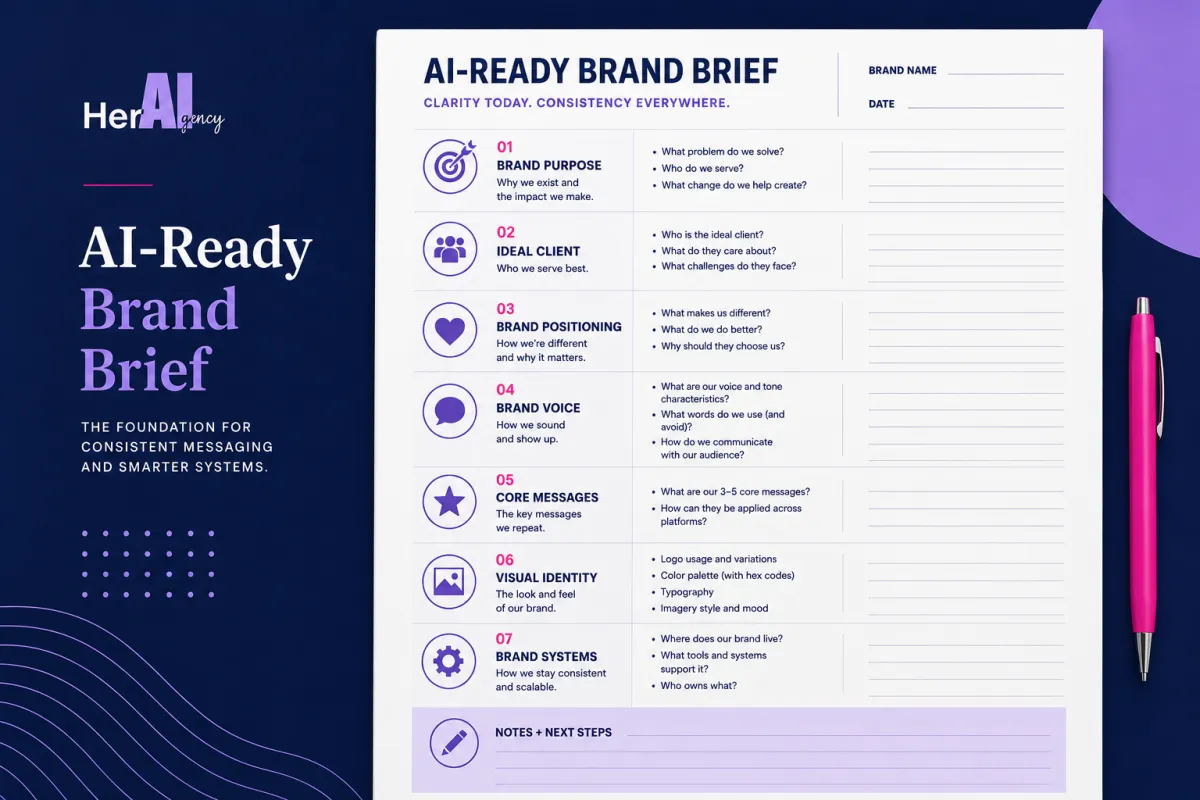
What Belongs in an AI-Ready Brand Brief?
A traditional brand guide helps people recognize the business.
An AI-ready brand brief helps people and tools understand how the business thinks.
That distinction matters.
A logo, color palette, typography system, mission statement, and list of tone words can support visual consistency. They do not tell an AI tool how to explain the offer, interpret the founder’s method, handle a sensitive claim, choose the right example, or decide when an output needs human review.
An AI-ready brand brief is not a prettier style guide.
It is a structured source of business knowledge.
It gives every tool, contractor, employee, and workflow a shared reference point for what the business means, how it speaks, and where its boundaries sit.
What makes a brand brief AI-ready?
An AI-ready brief should be specific enough to guide decisions, not just describe preferences.
Compare these two instructions:
Our voice is warm, confident, and professional.
We speak directly, name the specific problem, and explain the reasoning. We are warm without performing warmth. We do not use inflated claims, empty urgency, or generic reassurance. Founder content can use first person. Most website copy uses the brand name in third person.
The second version is more useful because it gives the reader standards they can apply.
That is the test for every section of the brief.
Can a person or tool use this information to make a better decision?
1. Audience context
Start with the people the business serves.
Do not stop at demographics or broad labels.
Document:
The primary audience
Secondary audiences
Business stage
Current situation
Most recognizable problems
What they have already tried
What they believe the problem is
What the business believes is actually happening
Buying motivations
Common objections
Signals that someone is ready
Signals that someone is not a fit
The difference between “consultants” and “established solo experts whose methodology lives in their heads” changes the content immediately.
One names a category. The other reveals the operating problem.
2. Offers
Each offer needs a clear internal definition.
Include:
Offer name
One-sentence description
Best-fit buyer
Problem solved
Trigger that creates urgency
Deliverables
Delivery format
Timeline
Pricing language that is approved for public use
Expected client responsibilities
What the offer does not include
Natural next step
Situations where another offer is a better fit
This prevents AI from combining offers, inventing deliverables, softening important distinctions, or sending every reader toward the same CTA.
3. Positioning
Positioning explains the place the business intends to occupy in the buyer’s mind.
Document:
The category the business belongs to
The category it does not belong to
The alternative the buyer is comparing
The central problem the brand owns
The clearest reason to choose this approach
What competitors or common industry advice tend to miss
Approved positioning lines
Claims that require proof
Language that should never appear
Good positioning gives the business a clear center.
Without it, AI tends to write toward whatever language is most common in the category.
4. Point of view
The point of view is the intellectual spine of the brand.
It should answer:
What do we believe?
What do we reject?
What do we see that the audience may not see yet?
Which misunderstanding are we trying to correct?
Which tradeoffs are we willing to name?
What do we want the audience to believe after spending time with us?
For HerAIgency, the point of view begins with structure:
Most founders do not have an AI problem. They have a clarity problem that AI made impossible to ignore.
That belief is not limited to one campaign. It guides content, recommendations, diagnostics, and offer routing.
5. Methodology
Experts often describe the outcome of their work but leave the process vague.
An AI-ready brief should document the method in enough detail to explain it consistently.
Include:
Method name
Stages or phases
Purpose of each stage
Inputs required
Questions asked
Decisions made
Deliverables created
Conditions that change the sequence
Common mistakes
What must happen before the next phase
Examples of the method in use
HerAIgency’s Align, Automate, Appear framework is sequential as a methodology, but flexible in entry point.
That distinction matters. A tool trained only on the three names could easily present them as a rigid package or use the labels too early in cold copy. The brief needs the application rules, not just the framework name.
6. Voice and tone
Tone words are a starting point, not a complete standard.
Document the voice with contrasts, examples, and context.
Include:
Core voice characteristics
Sentence rhythm
Level of formality
Preferred point of view
Founder voice versus brand voice
Tone by channel
Approved phrases
Banned phrases
Examples of copy that sounds right
Examples of copy that sounds wrong
Why each example works or fails
A useful voice guide explains how the same brand changes across a homepage, social post, email, proposal, and diagnostic tool without losing its identity.
7. Vocabulary and terminology
Terminology is operational.
Document:
Brand and product capitalization
Approved service names
Framework terms
Plain-language explanations
Words the audience uses
Words the business prefers
Terms that are easily confused
Words that should appear only in specific contexts
Acronyms and definitions
Naming rules for internal and public use
This is especially important when several people or tools create content.
One person’s harmless wording change can alter the meaning of an offer or send the wrong buyer down the wrong path.
8. Examples and proof
AI needs examples, but examples should be organized.
Include:
Strong content samples
Strong sales copy
Founder stories
Approved client examples
Case study summaries
Testimonials with permission status
Results with source and approval notes
Before-and-after examples
Common objection responses
Strong CTA examples
Label each item with its purpose.
“Good LinkedIn post” is less useful than:
Founder-led LinkedIn post for awareness-stage solo experts. Strong because it opens with a recognizable operational problem, names the belief shift, and ends with a diagnostic question rather than a sales CTA.
Proof should also include restrictions.
Note what can be used publicly, what must remain anonymized, and what requires approval each time.
9. Claims and boundaries
This section protects trust.
Document:
Claims the business can make
Claims that need evidence
Claims that are prohibited
Regulated topics that require review
Results that should never be generalized
Timelines that vary by client
Product limitations
Confidentiality rules
Language around guarantees
When founder review is required
When legal, compliance, or technical review is required
A useful AI workflow should know when to stop and ask for a human decision.
10. Use cases
The same brand information may be used differently across tasks.
List the approved use cases for the brief.
For example:
Social content
Blog outlines and drafts
Sales-page copy
Email nurture
Proposal development
Client onboarding
FAQ creation
Lead qualification
Internal training
Contractor briefing
Offer comparison
Customer support
Repurposing
Website updates
For each use case, note:
Required inputs
Expected output
Approved source material
Human review requirements
CTA rules
Risk level
Where the final version will live
This turns the brief into a working system instead of a document that sits in a folder.
How to use the brief across AI tools
A complete brief does not mean every tool needs every section for every task.
Use the smallest relevant set of information.
A social post may need the audience, point of view, voice, examples, and CTA rule.
A lead-qualification workflow may need the offer definitions, fit criteria, routing rules, approved language, and escalation conditions.
A website rewrite may need the audience, positioning, methodology, proof, claims boundaries, search intent, and internal links.
The foundation stays consistent. The context changes by task.
Review your current documentation
Open your current brand guide, strategy deck, onboarding documents, offer notes, and best-performing content.
Then ask:
Can someone explain our main offer without asking the founder to correct it?
Can someone describe our best client using more than a broad category?
Is our point of view written down?
Is our methodology documented as a sequence of decisions and actions?
Are voice standards specific enough to apply?
Are approved examples labeled?
Are proof and claims restrictions clear?
Do our tools know what requires human review?
Do we know which parts of the brief belong in which workflow?
Mark each area as:
Documented and usable
Partially documented
Known by the founder only
Missing
The “known by the founder only” category is usually where the business is most dependent on memory.
That is the work to prioritize.
The goal is shared understanding
An AI-ready brand brief is not about handing the business over to a tool.
It is about creating shared understanding.
The founder should not have to restate the audience, correct the offer, explain the method, and remove the same unwanted language every time someone creates a piece of content.
A strong brief gives the business a stable source of truth.
That makes AI more useful, contractors more consistent, employees easier to onboard, and decisions easier to review.
The tool is not the foundation.
The business knowledge is.
Review your current documentation against the ten categories above. Identify the first category that is still incomplete, inconsistent, or stored only in your head.
FAQ
What is an AI-ready brand brief?
An AI-ready brand brief is a structured source of business knowledge that helps people and AI tools understand the audience, offers, positioning, methodology, voice, vocabulary, examples, proof, boundaries, and approved use cases.
Is an AI-ready brand brief different from a brand guide?
Yes. A traditional brand guide often focuses on visual identity and high-level tone. An AI-ready brand brief also includes business logic, methods, language rules, examples, proof restrictions, and workflow-specific guidance.
Does every AI tool need the full brand brief?
No. Each task should use the sections relevant to that workflow. The full brief acts as the source of truth, while smaller context packets guide individual tasks.
How often should an AI-ready brand brief be updated?
Update it when the audience, offers, methodology, positioning, proof, vocabulary, or operating rules change. Assign an owner and record the latest approved version.
