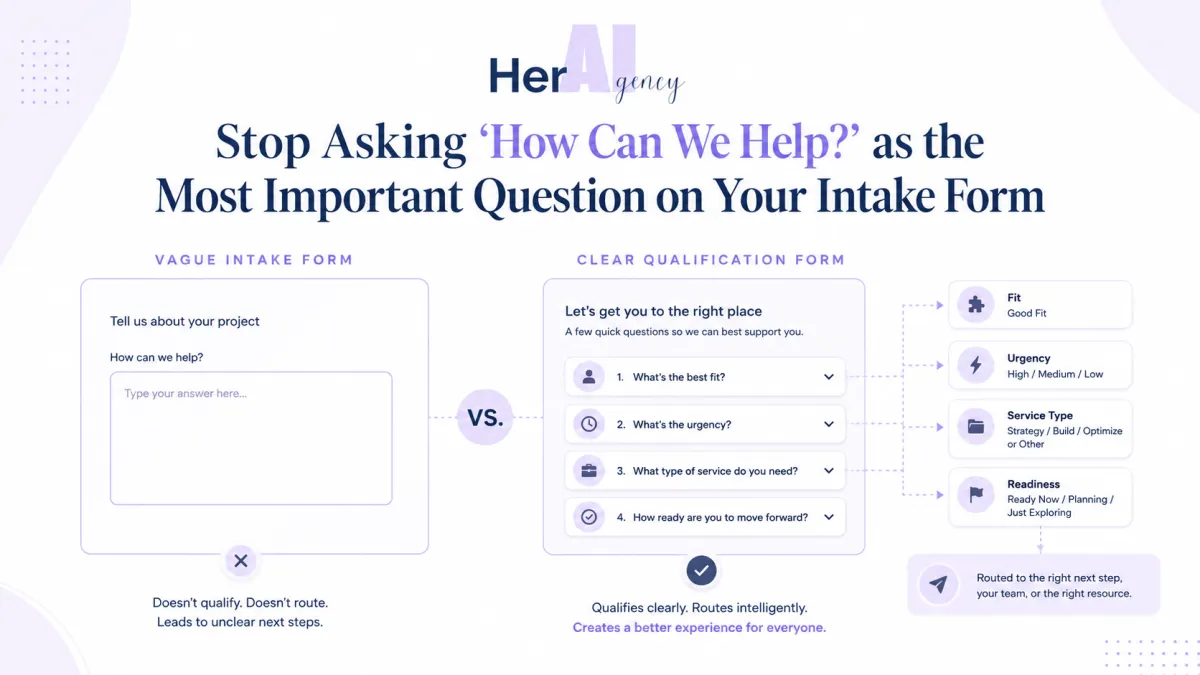
Stop Asking & 'How Can We Help? as the Most Important Question on Your Intake Form
A lead qualification form should do more than collect a message. It should help the business understand fit, urgency, service type, readiness, and the right next step.
'How can we help?' is not a bad question.
It is just not strong enough to carry your intake process.
Most leads do not know how to answer it in a way that helps you route them correctly. They may describe the symptom, not the real need. They may write one sentence when you need context. They may ask for one service when a different path would fit better.
The result is more manual interpretation for the founder.
The submission arrives, but the decision-making still has to happen after it: what they mean, whether they are a fit, whether they should book, what to ask next, and where the contact should go in the CRM.
That is not a clean intake path. It is a conversation starter with a lot of manual work attached.
What to ask instead
You may still include a version of 'What are you looking for help with?' But it should not be the only meaningful question.
The better question is: what does the business need to know in order to recommend the right next step?
For a consultant or strategist, that might include:
What prompted you to look for support now?
What decision, bottleneck, or project are you trying to move forward?
Have you already tried to solve this internally?
Who else is involved in approving the next step?
What would make the first conversation useful for you?
For a creative service provider, that might include:
What type of project are you considering?
What stage is the project in right now?
What outcome does this project need to support?
Do you have a target timeline or launch date?
Are you looking for strategy, execution, or both?
For a local or appointment-based service business, that might include:
Which service are you interested in?
Where are you located or where will the service happen?
How soon do you need help?
Are there any details we should review before recommending the next step?
Would you prefer to book now or have someone review your request first?
For a coach, expert, or education-based service, that might include:
What are you hoping to change or improve?
What have you already tried?
What kind of support are you looking for?
How ready are you to begin?
What would make this feel like the right fit?
The right questions depend on the offer. The goal is not more questions. The goal is better decisions from fewer, more useful questions.
A form is not an intake system
A form collects information.
An intake system uses that information to guide the next step.
That distinction matters.
If your form asks broad questions but does not help qualify the lead, the real intake work still happens after submission.
If your calendar link is available before the right questions are answered, the call may become a qualification call instead of a sales conversation.
If the CRM receives only basic contact details, the founder still has to reconstruct context from inboxes, notes, or memory.
The form is one piece.
The system includes the questions, routing logic, booking path, follow-up, internal notifications, and CRM connection.
Better questions create better routing
The purpose of intake is not to make the lead prove themselves.
It is to help both sides understand the right path.
Good intake questions clarify:
Fit: Is this person aligned with the service, stage, budget, location, or need?
Urgency: Do they need help now, soon, or later?
Service type: Which offer or pathway best matches the situation?
Readiness: Are they ready to book, or do they need education first?
Complexity: Is this a simple inquiry, a custom review, or a broader system need?
Those answers can shape what happens next.
A strong-fit lead may be sent to a booking page. A more complex inquiry may go to internal review. A lower- readiness lead may receive a resource. A specific service request may trigger a tailored follow-up. A non-fit inquiry may get a clear, respectful next step instead of silence.
That is routing logic.
And when routing logic is clear, the founder does not have to make the same decision from scratch every time.
The first response should match the lead's actual path
The first response after an inquiry does more than confirm receipt.
It sets the tone for the relationship.
A generic 'Thanks, we'll be in touch' may be polite, but it does not always reduce uncertainty. A better response tells the lead what happened, what to expect, and what they should do next.
If they are ready to book, the response should make booking easy.
If they need review first, the response should explain that clearly.
If they are not the right fit, the response should still feel thoughtful.
If they need a resource before a call, the response should send it without delay.
That kind of follow-up is difficult to maintain manually when inquiries are coming from multiple places.
It becomes easier when the intake path is connected to the CRM and the response logic is already built.
CRM connection turns intake into usable context
Many founders have contact records.
Fewer have useful intake visibility.
A useful CRM connection captures the information that matters: what the person asked for, which path they were routed to, what tags apply, what follow-up was sent, whether a task was created, and whether the person booked, paused, or needs review.
When that context is in the CRM, the founder does not start every conversation from a blank page.
The system has preserved the path between interest and commitment.
The best intake path feels clear, not heavy
A strong intake experience should not feel like a long application unless the offer requires it.
It should feel useful.
The lead should understand why they are being asked certain questions. The founder should get enough context to route correctly. The CRM should receive the information needed to support follow-up.
That is how the early lead experience becomes more than a form.
It becomes a front door that helps the right people move forward with less confusion and less manual coordination.
Book a call to map your first five minutes, or take the First Five Minutes Audit to see where your
intake process may be breaking down.
FAQ
What should a lead qualification form ask?
A lead qualification form should ask questions that clarify fit, urgency, service interest, readiness, timeline, and the best next step. The goal is not to ask more questions. The goal is to ask questions that support better routing and follow-up.
Is 'How can we help?' a bad intake question?
No. It can be useful as one open-ended question. But it should not be the only meaningful intake question because it usually does not provide enough information to qualify, route, or follow up with the lead correctly.
How many questions should a lead qualification form have?
A lead qualification form should usually ask enough questions to route the lead correctly without making the process feel heavy. For many service businesses, five to eight strong questions are better than a long form with weak answers.
What is routing logic in an intake process?
Routing logic is the decision structure that determines what happens after someone submits an inquiry. Based on the lead's answers, they may be sent to a booking page, internal review path, tailored follow-up, resource, or alternate next step.
