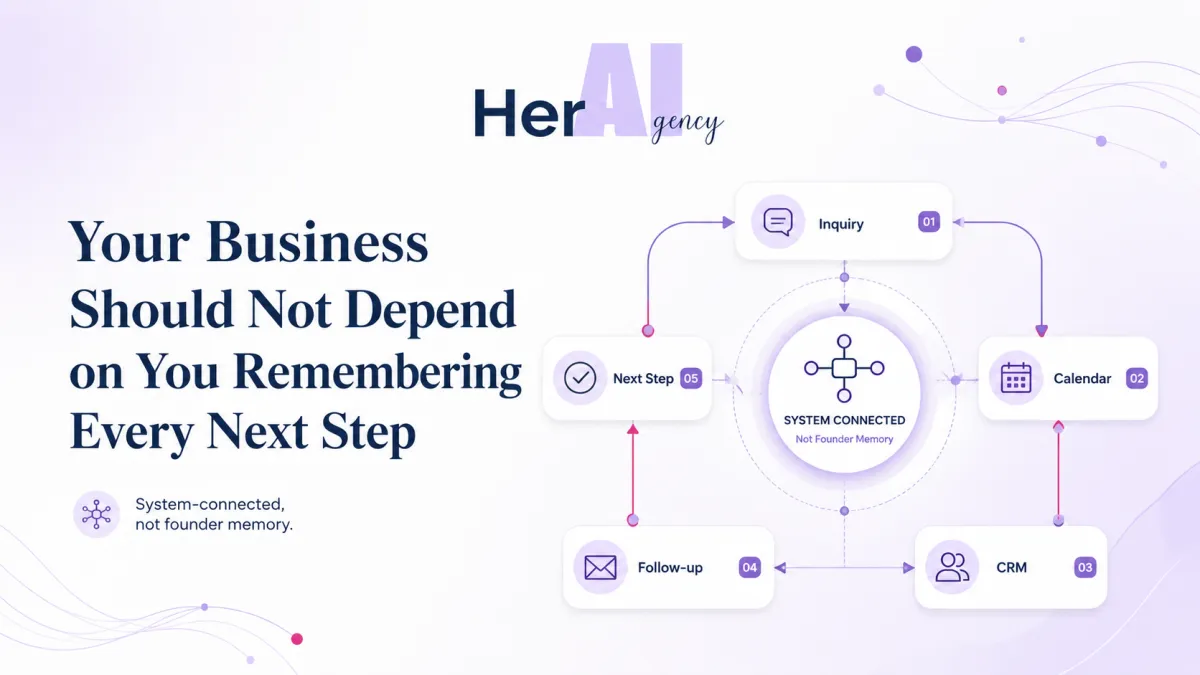
Your Business Should Not Depend on You Remembering Every Next Step
Manual follow-up gets heavy when the business needs the founder to connect inquiry, calendar, CRM, and next step by memory. The solution is not more self-discipline. It is a clearer client intake workflow.
Most founders are not forgetting because they do not care.
They are forgetting because too many parts of the business still depend on them as the connector.
The inquiry arrives in one place. The calendar lives somewhere else. The CRM has partial information. The follow-up is drafted manually. The decision about fit happens in the founders head.
For a while, that can feel manageable.
You know the business. You know the clients. You can usually tell who is serious, who needs more context, and who should be routed somewhere else.
But as the business grows, founder memory becomes a risky place to store the client journey.
Manual follow-up is not a character flaw
It is easy for founders to turn follow-up gaps into a personal story.
'I should be better at this.'
'I need to be more organized.'
'I need to check the CRM more often.'
'I need to respond faster.'
Sometimes those things are true in small ways.
But most of the time, the deeper issue is that the process asks too much of one person.
A strong intake system should not require the founder to remember every detail manually. It should know where the lead came from, capture what they need, categorize the inquiry, route the person based on fit or urgency, send the right follow-up, and update the CRM so the next conversation has context.
That is not about removing the founder from the relationship. It is about protecting the founder's attention for the moments that actually need her judgment.
What founder memory ends up carrying
A founder-dependent system has a specific kind of weight.
It is not always visible from the outside because the business still looks like it is working. Leads are coming in. Calls are happening. Clients are being served.
But behind the scenes, the founder is carrying open loops like:
Who needs a reply?
Who asked about pricing?
Who is a strong fit but needs more context?
Who should not be sent directly to the calendar?
Who needs to be added to the CRM before the context disappears?
That mental load is expensive.
It pulls attention away from delivery, strategy, content, and sales conversations that actually need the founder's expertise.
The moment after a lead shows interest should not add another open loop. It should close one.
The next step should not be invented every time
One of the clearest signs that the intake path needs structure is that the next step changes based on founder availability.
When you have time, you respond carefully. When you are busy, the reply waits. When the lead sounds promising, you ask better questions. When the message is vague, you are not sure whether to engage. When someone books too early, the call starts with basic qualification that could have happened before the calendar.
The business is not broken.
The decision logic is undocumented.
A better system decides in advance:
What makes someone a good fit?
What questions need to be answered before booking?
Which leads should go straight to a call?
Which leads should receive a resource or review path first?
Which inquiries need an internal notification?
Which contacts should be tagged in the CRM for future follow-up?
Once those decisions are mapped, follow-up becomes less dependent on memory.
CRM connection matters because context matters
A CRM is only useful when the right information reaches it.
If the form collects one version of the lead, the calendar captures another, and the inbox holds the actual context, the CRM becomes a partial record.
It may store the contact, but it does not give you a clean view of the relationship.
That is where many founders feel the friction.
They technically have tools. They technically have forms. They technically have a CRM. But the tools are not carrying the full client path.
A stronger CRM follow-up process captures the information that matters: what the person asked for, which path they were routed to, what follow-up was sent, what task or notification was created, and what should happen next.
When that context is visible, the founder does not have to piece the story back together later.
The goal is relief, not more software
The goal is not to add another thing to manage.
The goal is to make the lead experience clearer and the founder's role lighter.
Lighter means the founder can finish a client meeting without wondering whether an inquiry is sitting unanswered. It means a qualified lead can receive the right next step before the founder has a perfect window to respond. It means the CRM shows enough context that the next conversation does not start from scratch.
A lead should be able to raise a hand and receive a useful path.
The founder should be able to look inside the CRM and understand what happened.
Follow-up should begin without waiting for a quiet moment in the founde's day.
That is what App in a Day is built to install: a smarter front door for intake, qualification, routing, follow-up, and CRM connection.
Your business can still sound like you. Your standards can still shape the path. Your judgment can still matter where it belongs.
It just should not all depend on you remembering every next step.
Take the First Five Minutes Audit to see where your follow-up system may be carrying too much of the process manually.
FAQ
Why is manual follow-up hard to maintain?
Manual follow-up is hard to maintain because it often depends on the founder remembering each inquiry, interpreting fit, sending the right next step, updating the CRM, and checking back later. As the business grows, that process becomes harder to hold manually.
Does automation make follow-up feel impersonal?
It can if the underlying message and routing logic are generic. A better system uses clear intake questions, thoughtful response paths, and brand-specific follow-up so the lead receives the right next step without losing the founder' voice.
What should a CRM follow-up process include?
A CRM follow-up process should capture lead source, intake answers, fit indicators, service interest, routing path, follow-up status, internal tasks, and next-step visibility.
