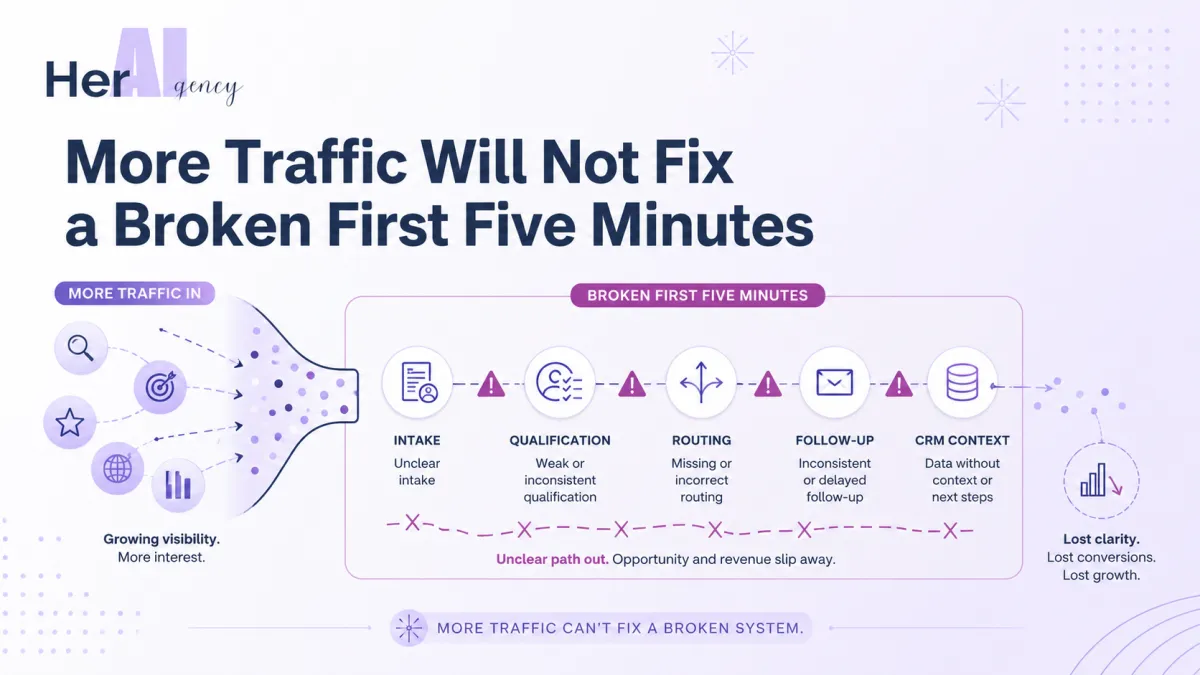
More Traffic Will Not Fix a Broken Lead Intake Process
More traffic can create more attention, but it cannot repair the intake window after someone shows interest. If the next step, routing, follow-up, and CRM context are unclear, visibility may send more people into a process that still depends on the founder to hold it together.
More traffic can create more attention.
It cannot fix what happens after someone shows interest.
That is where many service businesses quietly lose momentum. Not because the founder is careless. Not because the offer is weak. Not because the lead was never serious.
Because the moment after interest is doing too much manual work.
Someone lands on your site, fills out a form, sends a message, asks a question, or clicks a booking link.
From their side, they are looking for the next clear step.
From your side, the process may depend on a chain of things happening correctly: the inquiry gets noticed, the right questions get asked, the lead gets routed, the follow-up goes out, and the CRM gets updated with enough context to support the next conversation.
None of those steps are complicated by themselves.
Together, they create a fragile first response path.
And when that path is unclear, more traffic usually creates more pressure, not more control.
More traffic cannot fix the lead intake process
A lead intake process is the path someone follows after they show interest.
It includes the form they complete, the questions they answer, the response they receive, the booking or review path they are sent to, and the way their information is captured in the CRM.
If that path is vague, slow, or dependent on founder memory, more traffic does not solve the problem. It simply sends more people into the same fragile system.
That is why the answer is not always more visibility.
Sometimes the better question is: what happens after someone decides they are interested?
The problem is not always visibility
A founder can be visible and still have an intake problem.
People can find the business, understand the offer, and feel interested enough to act. But if the next step is vague, too open-ended, or slow to arrive, the lead experience starts to lose shape.
A contact form that says 'How can we help?' may collect information, but it does not qualify the lead.
A calendar link may create bookings, but it does not always route the right people to the right conversation.
A CRM may store the contact, but it does not automatically create a clear follow-up path unless the logic has been built.
Before you invest in more visibility, check whether your intake and follow-up path is ready to receive it.
What happens after someone fills out your contact form?
The contact form is usually treated as the finish line.
It is not.
It is the beginning of the lead experience.
After someone fills out a form, the business needs to know what should happen next.
Should the lead book a call immediately?
Should they answer more qualifying questions first?
Should they be routed to a specific service path?
Should the inquiry go to internal review?
Should they receive a resource before a conversation?
Should the CRM create a task, tag, or follow-up sequence?
If those decisions are not mapped, the founder becomes the routing system.
That can work until the volume increases, the business gets busier, or the follow-up depends on finding the right moment to respond.
The intake window should answer three questions
A strong early lead experience does not need to be complicated. It needs to be clear.
For the lead, it should answer:
1. Am I in the right place?
2. What should I do next?
3. What happens after I take that step?
For the business, it should answer:
4. Is this person a fit?
5. Which path should they follow?
6. Does the founder need to respond personally right now?
That is where intake friction usually appears. The lead is ready enough to raise a hand, but the business has not decided what should happen next.
Those decisions should not have to happen manually every time.
Founder-dependent systems carry a real emotional cost
The hidden cost of a weak first response path is not just missed opportunity.
It is the mental tab that stays open.
You wonder whether the reply went out. You reread messages to remember context. You check the CRM and realize the contact never made it there. You try to follow up, but now the moment feels colder.
That kind of system can work for a while, especially in a small business. But as the business grows, it starts taking more attention than it should.
The founder becomes the connection between the form, inbox, calendar, follow-up, and CRM.
The process can look functional from the outside while still feeling heavy on the inside.
What a better lead follow-up process can look like
A better path gives both sides more context and less confusion.
For example, a consulting lead completes a short intake. Their answers show they are a strong fit but need internal review before booking. Instead of landing on a generic thank-you page, they receive a clear note explaining what happens next. The CRM creates the contact, stores the intake answers, tags the inquiry by service type, and alerts the founder to review it.
The lead is not left wondering whether the message disappeared.
The founder is not reconstructing the story from a form notification, inbox thread, and calendar entry.
The system has preserved the context and moved the relationship to the right next step.
This does not replace the relationship. It protects the relationship by making sure the first response is useful, timely, and aligned with what the lead actually needs.
How App in a Day rebuilds the path between interest and commitment
App in a Day rebuilds the front door of the client journey: intake, qualification, routing, follow-up, and CRM connection.
It is built in one focused sprint so leads can move forward without the founder manually holding every step together.
No matter where someone finds you, your business has a first five minutes.
The question is whether those minutes are making the next step easier to trust.
Take the First Five Minutes Audit to see what new leads actually experience before they ever talk to you.
FAQ
What are the first five minutes in a service business?
The first five minutes are the early steps after a lead shows interest. This may include the contact form, intake questions, booking link, first response, follow-up, routing, and CRM update.
Why does more traffic not fix poor lead follow-up?
More traffic creates more attention, but it does not automatically create a clearer next step. If the lead intake and follow-up process is slow, vague, or manual, more visibility can increase pressure without improving conversion readiness.
What should happen after someone fills out a contact form?
The lead should receive a clear next step. The business should capture the right information, identify fit or urgency, route the inquiry correctly, send appropriate follow-up, and store the context in the CRM.
