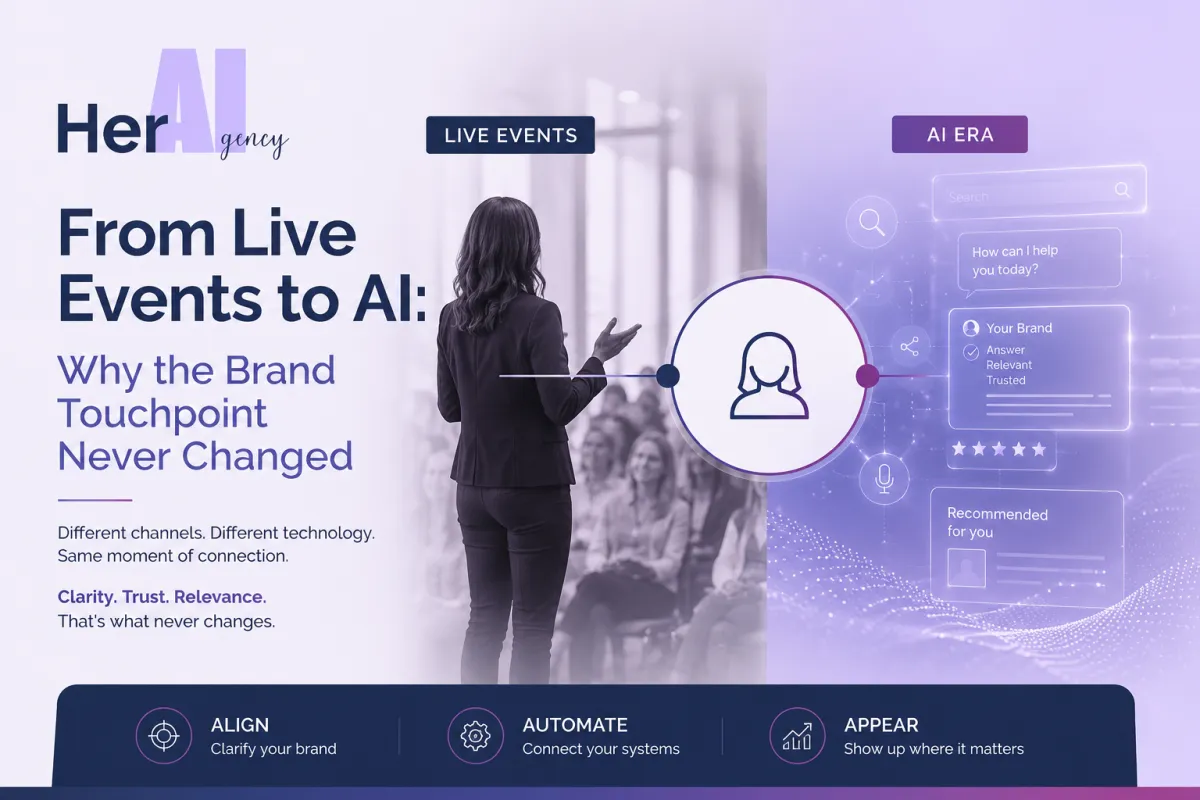
From Live Events to AI: Why the Brand Touchpoint Never Changed
From Live Events to AI: Why the Brand Touchpoint Never Changed
People often ask me how I went from nearly 20 years in events to running an AI consultancy.
On the surface, I understand the question.Events feel human. AI feels technical.
Events happen in rooms, around people, through conversations, hospitality, timing, energy, and shared experience. AI happens through systems, software, prompts, automations, search results, chatbots, workflows, and digital interfaces.
They seem like completely different worlds. But to me, the work never actually changed.
The medium changed. The brand touchpoint did not.
Before I built AI systems, automation workflows, and visibility strategies, I built live events. Conferences. Corporate events. Sponsorship programs. Strategic gatherings. Brand experiences designed to bring people together around a company, a message, a relationship, or a business goal.
And I was not just planning agendas or coordinating logistics.
I was designing brand experiences. That distinction matters.
A well-designed event is much more than a room full of people. It is a structured, intentional experience where every detail communicates something about the company behind it.
The invitation shapes the first impression. The registration process either creates confidence or friction. The communication before the event tells people whether they are being guided or left to figure things out.
The signage, timing, speakers, room layout, sponsor presence, food, flow, hallway conversations, and follow-up afterward all influence how someone feels about the brand.
When the experience is strong, people feel it.
They feel guided. They feel informed. They feel connected. They feel like the company thought through their needs before they even had to ask.
That is why events are one of the most powerful forms of marketing. They allow people to experience a brand in real time.
A strong event can build trust faster than almost anything else because it makes the brand tangible.
Events Are Not Just Experiences. They Are Business Infrastructure.
One of the biggest misconceptions about events is that they are simply a marketing expense.
A line item. A cost center. A “nice to have.” But when events are designed strategically, they become much more than that.
They become relationship infrastructure.They become sales infrastructure.They become visibility infrastructure.
They become a way for a business to deepen trust, create momentum, move people toward action, and make the brand feel real.
I have seen this at every level. I have personally helped move an event program that had been treated as a marketing cost center into a full-fledged brand event program grossing millions per year.
That does not happen because an event looks nice. It happens because the event becomes part of the business strategy.
The room is not the strategy. The experience is.
The agenda is not the strategy. The movement through the agenda is.
The sponsor package is not the strategy. The value created for sponsors, attendees, partners, and the business is.
The follow-up email is not an afterthought. It is part of the relationship.
That work taught me something I still believe deeply:
Every interaction shapes how people understand a business.
The obvious moments matter, but so do the overlooked ones. The confirmation email. The check-in table. The waiting period before a session starts. The way a sponsor is introduced. The clarity of the next step. The follow-up after the room clears.
Those details either strengthen the promise of the brand or quietly weaken it. That was my training ground.
Events taught me to think about the full path someone takes with a business. Not just what the company wants to say, but what the person on the other side needs to understand, feel, trust, and do next.
Why My Move Into AI Was Not Really a Pivot
So yes, it might seem strange that my work eventually led me into artificial intelligence.
For some people, live events and AI feel like opposites. One is deeply human. The other feels highly technical and sometimes even scary. One happens face to face. The other happens through software.
But the more I worked with AI, the more I realized I had not changed disciplines. I had found a new medium for the same work.
Long before AI became mainstream, customer behavior was already shifting. People were spending more time online. They were researching more before making decisions. They expected immediate answers, clearer information, and faster paths to the next step.
Then COVID accelerated everything.
Live events stopped almost overnight. Digital behavior intensified. Businesses that had relied heavily on face-to-face relationships had to rethink how trust was built.
At the same time, customers became more comfortable making significant decisions online. They booked services, purchased products, signed contracts, joined programs, hired providers, and chose companies without ever meeting someone in person.
Attention moved. Trust moved with it. Businesses had to adapt. That is the part that connects live events to AI.
The format changed, but the job did not.
Your Digital Touchpoints Are Now Part of the Brand Experience
In an event, you never assume the experience will take care of itself.
You think about the path people will take.
Where do they enter? What do they see first? What questions might they have? Where could friction happen?
When does a person need to step in? What do they need before they can trust the next step?
AI-powered systems require the same kind of thinking. A search result is now a first impression. A landing page is now part of the sales conversation. An intake form is now part of the customer experience. An automated email is now part of the follow-up.A chatbot is now part of the front desk. A booking confirmation is now part of the trust-building process.A support response is now part of the relationship.
These touchpoints may happen through software, but they still shape how someone experiences your business.
They either build confidence or quietly weaken it.
That is why AI cannot be treated like a separate tool sitting outside the business.
AI Does Not Remove the Need for Brand Strategy. It Raises the Stakes.
When I first heard about ChatGPT, I remember doing what many people did. I searched, “What is ChatGPT?”
At first, I was curious about the tool itself. But as I started experimenting with it, I recognized something familiar.
It could reduce friction. It could create consistency. It could extend communication. It could help people get to the right information faster.
Those were not new goals.They were the same goals I had been building around for years in live events.
The delivery mechanism was different, but the strategic questions were the same.
What does this person need to understand?
What information would reduce uncertainty?
Where are they likely to get stuck?
What should happen next?
When does a human need to step in?
That is why my move from live events to AI was not a pivot away from branding. It was an extension of the same work.
A well-designed event helps someone move through an experience with more clarity. A well-designed AI-powered system should do the same.
It should answer the right questions.
It should reduce unnecessary friction.
It should guide people to the right next step.
It should create consistency across the business.
It should protect the moments where human judgment still matters.
That last part is important.
AI should not replace the human parts of your business that create trust, care, nuance, and connection.But it can support those moments by making the rest of the experience clearer, faster, and easier to navigate.
The Problem Is Not AI. The Problem Is Misalignment.
This is where many businesses get into trouble.
They start with the tool.
They ask:
What AI tool should I use? What can I automate? How can I create more content? How can I respond faster?
How can I generate more leads? Those are not bad questions, but they are not the first questions.
The first questions should be:
Is our message clear? Is our customer journey clear? Are we answering the questions people actually have?
Do our systems reflect how we want people to experience our business? Are we creating trust or adding friction?
Do we know when AI should help and when a human should step in? Because before AI writes for your business, responds for your business, qualifies leads for your business, or represents your business in search, it needs something clear to represent.
If the brand is unclear, the AI experience will be unclear.
If the system is inconsistent, the output will be inconsistent.
If the process is misaligned, the technology does not solve the problem. It scales it.
That is why AI strategy has to start with alignment. Not because alignment sounds nice.
Because alignment is what gives the technology something useful, accurate, and trustworthy to carry forward.
What This Means for Businesses Using AI Now
AI is already changing how people discover, evaluate, and interact with businesses.
People are not only searching Google anymore. They are asking ChatGPT, Perplexity, Gemini, voice assistants, and other answer engines for guidance.
They are looking for faster answers. They are comparing options before they ever fill out a form.
They are making decisions based on what your website, content, reviews, systems, and digital presence communicate before they ever speak to you.
That means your business has to be clear in more places than ever before.
Your website needs to answer real questions. Your content needs to reflect actual expertise. Your automations need to feel helpful, not careless. Your AI tools need to be trained on accurate business information. Your intake process needs to guide people toward the right next step.Your follow-up needs to support the relationship instead of making people feel like they entered a generic funnel.
These things are not separate from your brand.
They are your brand in action.
The Brand Touchpoint Never Changed
Whether someone interacts with your business at a live event, on your website, through an automated workflow, inside an AI assistant, or through a search result, the experience should feel intentional.
That does not mean every interaction needs to be overly polished or emotionally dramatic.
It means the experience should be clear.
It should be useful.
It should be aligned.
It should help people understand who you are, what you do, who you help, and what should happen next.
The businesses that understand this will have an advantage. Not because they use more tools. Not because they automate everything. Not because they publish more content with less effort.
They will have an advantage because they understand that AI is not just a productivity layer. It is becoming part of the customer experience.
And customer experience is brand experience.
Before you automate more, align first. Before you ask AI to represent your business, make sure your business is clear enough to be represented. Before you build more workflows, content, bots, and systems, ask the same question I learned to ask through years of designing live brand experiences:
What does this interaction teach someone about your business?
That question still matters.
Maybe now more than ever.
FAQ
How is AI connected to brand experience?
AI is connected to brand experience because it increasingly shapes how people discover, evaluate, and interact with a business. Search results, landing pages, chatbots, intake forms, automated emails, and AI-generated content all influence whether someone feels clear, confident, and ready to take the next step.
Why should businesses align their brand before using AI?
Businesses should align their brand before using AI because AI needs clear inputs to create useful outputs. If the message, customer journey, offer, or internal process is unclear, AI will often amplify that confusion instead of solving it.
Can AI improve the customer experience?
Yes, AI can improve the customer experience when it is used intentionally. It can answer common questions, reduce response time, guide people to the right next step, support lead qualification, and create consistency across digital touchpoints. The key is knowing where AI should help and where human judgment still matters.
Is AI a replacement for human connection in business?
No. AI should not replace the human connection that builds trust, nuance, and relationship depth. The strongest AI systems support human connection by reducing friction, improving clarity, and making it easier for people to get the help or information they need.
What should a business do before automating with AI?
Before automating with AI, a business should clarify its message, customer journey, offers, frequently asked questions, lead qualification process, follow-up process, and escalation points. AI works best when it is built on a clear, aligned foundation.
At HerAIgency, we help women-led businesses align their message, automate intentionally, and build visibility systems for the way people search, choose, and trust businesses now.
If your business is ready to use AI in a way that feels clear, strategic, and human, start with alignment.
